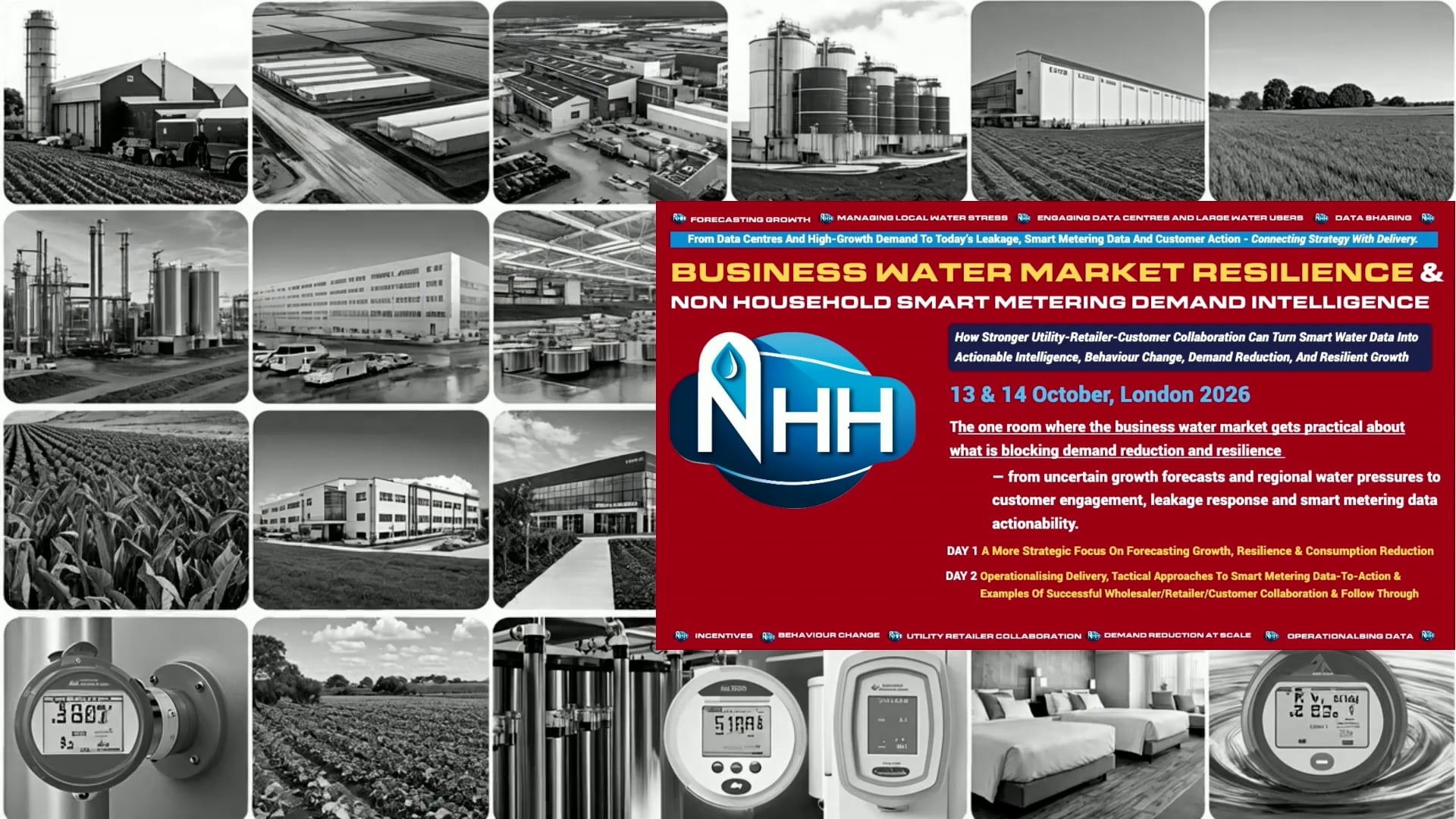
Over the last several weeks, we have been engaging in research consultation and structured market feedback with water utilities, retailers, market participants, smart metering specialists, and major non-household water users.
Across those conversations, the same pressures came up again and again:
- Uncertain growth from AI data centres, advanced manufacturing, logistics, healthcare, public estates, campuses, food production, and other high-consumption users
- More localised water stress and greater pressure on resilience planning
- Forecasting methods that still matter, but are not always granular enough for fast-changing business demand
- Smart metering programmes that are improving visibility, but still need to turn data into measurable savings beyond continuous flow and isolated leakage case studies
- Retailer-wholesaler coordination that has to move beyond general collaboration language into practical incentives, workflows, customer engagement, and follow-through
- Large users who need clearer insight into their consumption, leakage, wastage, process efficiency, and future demand
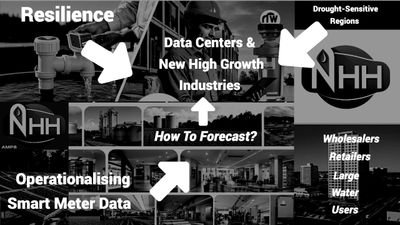
- A growing need to connect strategic planning with operational delivery, rather than treating resilience forecasting and smart meter data as separate conversations
This is why the event is not a pure water resource planning event.
And it is not a pure smart metering event either.
It is about the practical bridge between the two.
Business water demand is becoming harder to forecast, harder to manage, and harder to reduce in the places where it matters most. At the same time, the market is still working through the reality of how to turn smart meter installation, data availability, alerts, dashboards, retailer engagement, and customer conversations into actual reductions in consumption.
That is the central challenge this event is designed to address:
How does the non-household market use better forecasting, better consumption insight, better retailer-customer engagement, and smarter operational delivery to reduce demand where it is genuinely achievable — without pretending the market is already more joined up than it really is?
That question sits at the centre of this year’s agenda, shaping sessions on future business demand, data centres and high-growth users, regional resilience, retailer-wholesaler incentives, smart metering delivery, data quality, continuous flow, customer engagement, benchmarking, and measurable savings.
Across two days of sessions, case studies, panels, roundtables, and peer exchange, the agenda is designed to help attendees understand:
- How future business water demand is changing
- Where forecasting assumptions are weakest
- Which high-growth sectors are creating new local pressure
- How utilities can improve planning visibility before demand arrives
- How smart meter data can support operational action today and better planning over time
- How retailers can turn insight into useful customer conversations
- How major users can understand their own consumption, leakage, wastage, and efficiency opportunities
- How customer engagement can be made more targeted, practical, and commercially realistic
- How demand reduction can be measured, verified, and repeated
- How the market can move from fragmented data and siloed responsibility towards a more coordinated operating model
Specific Drill-Down Sessions Include
Forecasting Non-Household Demand In A Changing Economy
This session will examine how utilities are currently forecasting future business demand, where historic assumptions are becoming weaker, and how economic growth, planning pipelines, smart meter data, retailer intelligence, and customer-side behaviour can be brought together more effectively.
The point is not to talk vaguely about “growth”. The point is to ask where demand is actually changing, which sectors are creating localised pressure, what data utilities can realistically access earlier, and how forecasts can become more useful before demand arrives.
Attendees will explore:
- Where current forecasting models are still useful
- Where they are too broad for fast-moving non-household demand
- How data centres, manufacturing, logistics, healthcare, public estates, and campuses are reshaping local demand
- What retailers and large users can contribute to better demand intelligence
- How smart meter data may support more dynamic forecasting over time, without pretending most programmes are already there
Understanding Data Centres — Without Letting The Data Centre Topic Dominate The Agenda
Data centres matter. They are visible, politically sensitive, locally concentrated, and often difficult to forecast with confidence.
But the event will not allow the data centre topic to swallow the wider business water demand conversation.
Sessions will explore the practical questions data centres raise around cooling models, ramp-up profiles, water-energy trade-offs, non-potable water options, planning timelines, local infrastructure constraints, and what developers should share with utilities earlier.
They will also cut through some of the conflicting media noise around data centre water use, including reports of moratoriums and planning restrictions in the US, and ask what the real lessons are for utilities, retailers, planners, and large users in the UK and Europe.
The bigger issue is not simply “data centres use water”.
You told us that the bigger issue is this:
How do water-stressed regions plan for concentrated demand growth when the users creating that demand may not yet know their final water profile, cooling strategy, operational ramp-up, or long-term resilience requirements?
Planning For Other High-Growth Industries, Including Advanced Manufacturing, Life Sciences & Process-Driven Demand
Data centres are only one part of the picture.
The agenda will also examine how advanced manufacturing, life sciences, food and drink production, logistics hubs, healthcare estates, public-sector estates, campuses, and industrial clusters create demand patterns that are often more complicated than traditional sector forecasts suggest.
These users may have very different water profiles depending on production cycles, cleaning regimes, cooling requirements, process intensity, operating hours, expansion plans, and site-level efficiency opportunities.
Sessions will examine how utilities, retailers, and customers can better understand:
- Which sectors are driving new local pressure
- Which users are genuinely high consumption
- Which users are high risk because of resilience requirements
- Which sites offer realistic demand-reduction opportunities
- What data major users can share earlier without overcommitting
- How water efficiency can support growth without becoming anti-growth
Utility-Retailer Coordination Beyond “Better Collaboration”
The market already knows that wholesalers and retailers need to work together more effectively.
The useful question is: what exactly has to change?
This part of the agenda moves beyond vague relationship language and focuses on the mechanics of delivery.
Sessions will ask:
- What exactly should wholesalers share with retailers?
- What do retailers need in order to act?
- What workflows are missing?
- Where does accountability sit?
- Who owns the customer conversation?
- How can both sides avoid confusing or duplicating messages to the customer?
- How do alerts, leakage insight, consumption reports, and efficiency opportunities actually move through the market?
This is where the event gets practical. Because if data does not move through the market in a usable way, and if retailers do not have a realistic model for acting on it, then smart metering value will remain limited.
Commercial Incentives For Demand Reduction
Everyone knows in the UK water market that in demand reduction will not scale on goodwill alone.
This session will examine what would make demand reduction commercially viable for retailers, attractive to customers, and valuable for utility resilience planning.
Part of this requires a serious look at the incentives that could make action more realistic, including:
- Service incentives
- Data incentives
- Reputational incentives
- Performance incentives
- Tariff structures
- Regulatory boundaries
- Shared-savings models
- Customer value propositions
- Commercial models that reflect retailer margins and market realities
Sessions will discuss what kind of commercial and operational models are allowed and could be made to work, which would make demand reduction worth acting on for every part of the market.
Making Water Resilience Relevant To Different Types Of Business Customers
Wholesalers and retailers understand that major water users do not all think about water in the same way. It was discussed a lot at the conference last year.
For some, water is mainly a cost issue. For others, it is a resilience issue, a production issue, a facilities issue, a compliance issue, a tenant issue, a clinical safety issue, or a business continuity issue.
Multiple sessions will examine what different customers actually care about, including:
- Cost
- Continuity
- Operational risk
- Business resilience
- Facilities management
- ESG and reporting
- Production disruption
- Tenant behaviour
- Customer service
- Critical estate resilience
The point is to make customer engagement more calibrated for specific sites.
A hospital campus, manufacturing plant, logistics estate, university, retail portfolio, and data centre do not all respond to the same message. If the market wants customers to act, it needs to understand what action looks like inside different organisations.
Smart Metering Is Moving From Installation To Operational Value
The research also showed that the smart metering conversation is changing.
The industry is no longer only asking whether meters can be deployed.
It is asking what happens after they are installed.
That is why Day Two focuses on the operational reality of smart metering and non-household meter data — not exclusively the data itself, but the retailer coordination, customer engagement, workflows, and follow-through needed to turn visibility into reduced avoidable consumption.
The focus will be on real implementation lessons:
- Deployment challenges
- Retailer coordination
- Customer engagement
- Data quality
- Continuous flow detection
- Difficult commercial properties
- Benchmarking
- Measurable savings
- What actually changes after the meter is installed
Sessions all about turning visibility into action.
Specific Day Two Focus Sessions Will Include
Turning Smart Meter Data Into Operational Action
This session will look at the practical workflows required to act on data quickly, consistently, and commercially.
It will examine prioritisation, alert management, operational integration, escalation routes, issue ownership, retailer engagement, and how utilities and retailers decide which issues matter most.
Retailer-Wholesaler Operational Coordination
This session will focus on the operating model behind smart meter data.
It will explore how wholesalers and retailers coordinate around alerts, customer communication, data interpretation, issue validation, escalation, and follow-up.
The aim is to identify the practical workflows that allow smart meter data to become customer action rather than market noise.
Commercial Leakage & Continuous Flow Detection
Commercial leakage and continuous flow remain among the most immediate use cases for non-household smart metering.
Sessions will look at how continuous flow is identified, validated, prioritised, communicated, acted on, repaired, and measured. It will also explore how different property types affect interpretation, because continuous flow in one site may be leakage, while in another it may reflect legitimate operational use.
Alert Prioritisation & Avoiding Operational Overload
One of the big risks with smart metering is that it creates more visibility than teams can realistically respond to.
We aim to examine how utilities and retailers prioritise alerts by volume, duration, location, customer type, likely leakage value, water-stress relevance, operational risk, and probability of customer action.
Customer Engagement & Behavioural Response
This session will look at what actually makes business customers respond to water-use insight.
Attendees will explore which sectors engage most effectively, what messaging changes behaviour, how dashboards are used, what makes customers ignore alerts, and how engagement can be sustained beyond the first leak notification or usage report.
This is where the smart metering conversation becomes a customer behaviour conversation.
Complex Sites & Difficult Commercial Properties
The event will also return to one of the strongest practical topics from last year: complex sites and difficult commercial properties.
This year, the focus moves further into solutions for operationalising smart meter data across sites such as:
- Hospitals
- Campuses
- Manufacturing sites
- Mixed-use properties
- Shopping centres
- Older commercial buildings
- Public estates
- Industrial facilities
These sites are difficult because usage patterns are not always obvious. Some operate 24/7. Some have shared supplies. Some have tenants. Some have process water. Some lack sub-metering. Some cannot isolate or repair quickly without operational disruption.
This session will explore how to interpret smart meter data properly in those environments — and how to turn it into realistic action.
Measuring Savings, ROI & Proof Of Impact
How do NHH smart metering programmes demonstrate measurable value?
This session will examine how savings are calculated, how baselines are set, how leakage reductions are verified, how customer action is tracked, how ROI is communicated, and how investment cases are strengthened.
Day Two closes around a practical benchmarking roundtables, helping attendees compare where they are on the journey from meter installation to measurable demand reduction.
The aim is for attendees to leave with a clearer view of:
- What is working
- Where delivery is stuck
- Which workflows need improvement
- Which customer segments are responding
- Where savings can be verified
- And how smart metering can become a repeatable demand-reduction tool rather than just a data programme
Together, the two days create a practical bridge between strategic resilience planning and measurable market action.